On Monday Nov. 17, a group of students hosted the Cromwell Day Student Town Hall in Weinstein Auditorium following heavy backlash regarding the events from this year’s Cromwell Day. Organizers Salma Baksh ‘28 and Karolina Aldarondo ‘28 emphasized the importance of continued, open communication and community in the wake of the student walkout earlier this month, leading an open mic and group discussions.
On Nov. 6, Farah Pandith ‘90 returned to her alma mater to give the Keynote speech on the 36th annual Cromwell Day. Amidst a day of workshops, performances and exhibits, Pandith’s speech was met with an organized student walkout from John M. Greene Hall (JMG).
The walkout began as Floyd Cheung, Vice President for Equity and Inclusion, began to introduce Pandith as the keynote speaker. Students stood and filed out of JMG before Pandith took the stage, many relocating to gather on Chapin Lawn.
The walkout largely stemmed from criticism surrounding Pandith’s professional background. The major roles of her career include her membership in the Homeland Security Advisory Committee, Director for Middle East Regional Initiatives for the National Security Council, the first-ever Special Representative to Muslim Communities, Senior Fellow at the Council on Foreign Relations and Senior Advisor at the Anti-Defamation League (ADL).
During her speech, Pandith did not directly comment on the walkout. Instead, she began her address by reflecting on the origins of Cromwell Day and her role in its inception, 36 years prior in the very same auditorium.
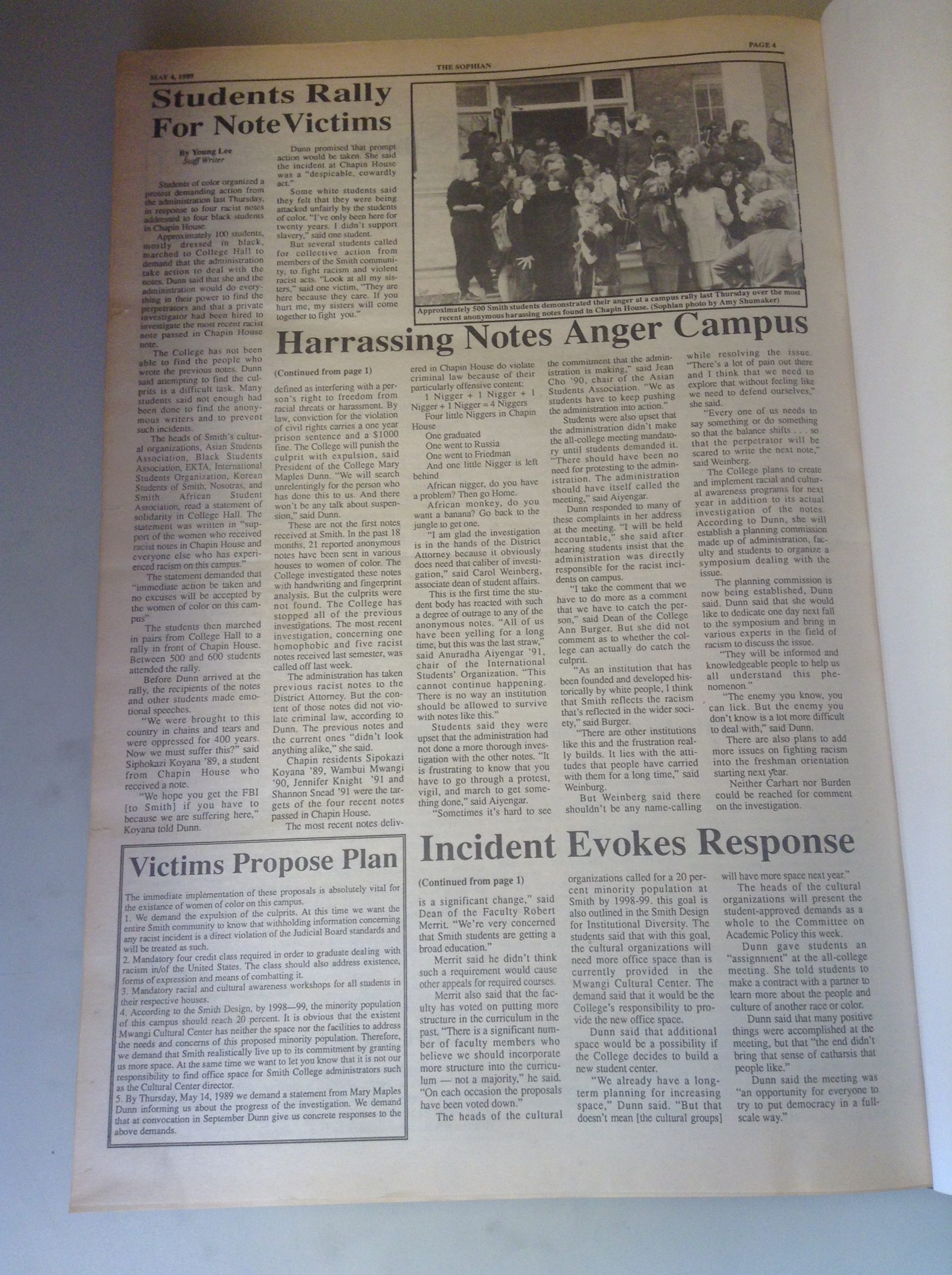
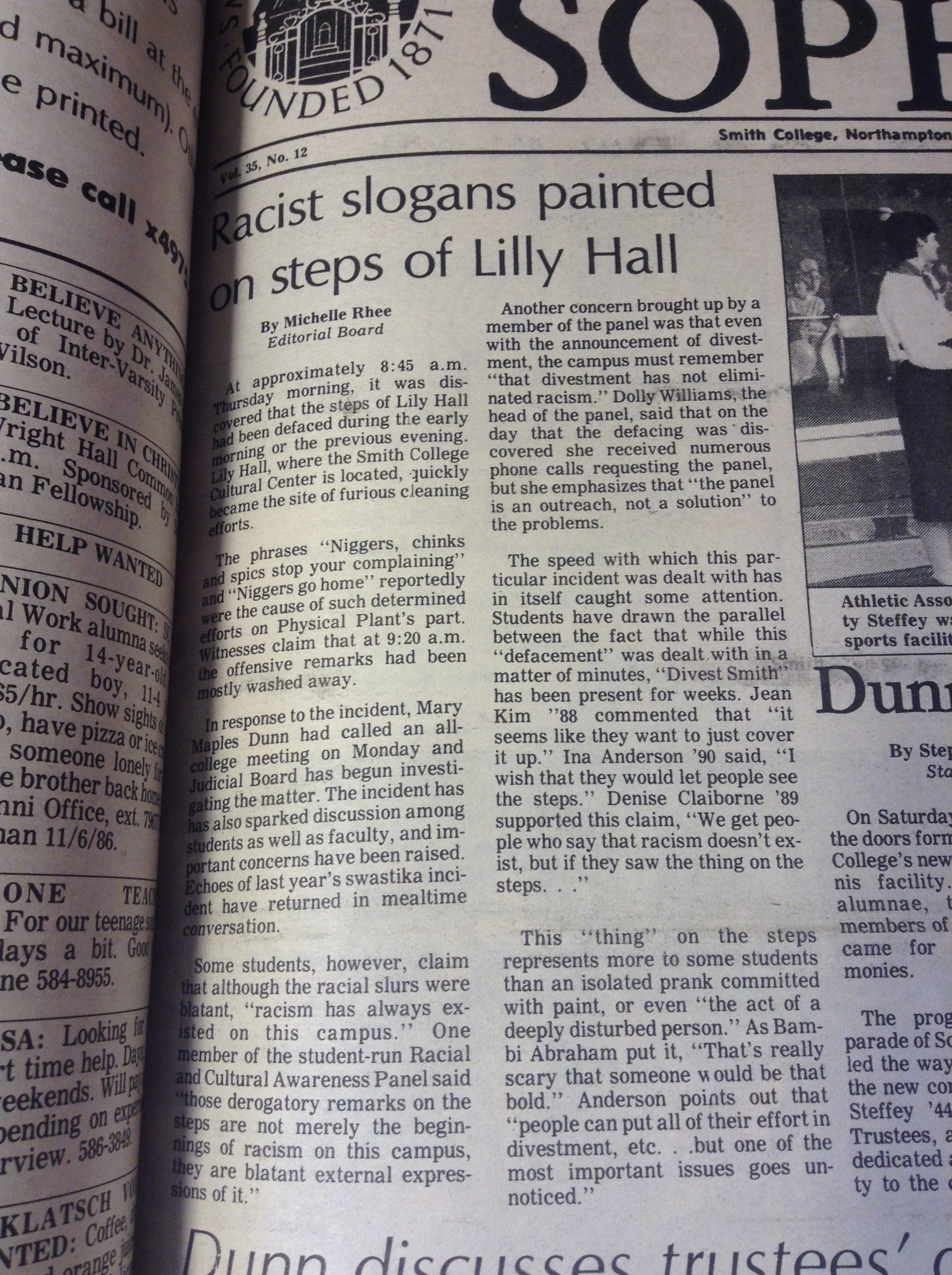
In the spring of 1989, four targeted notes containing racial slurs were sent to Black residents of Chapin House. These bigoted attacks were not uncommon at that time: The Sophian’s 1989 May Issue reported that 2 anonymous racist, antisemitic, and homophobic notes had been sent across campus within an 18 month span. One victim received five racially-charged notes in a four-week period. That previous fall, vandals spraypainted Lilly Hall with graffiti containing racial slurs and telling minority groups to “stop complaining” and “go home.”
The Chapin notes were a breaking point and the hate crime sparked a surge of protests, vigils, and discussions. College President Mary Maples Dunn turned the notes into the district attorney’s office and called on the FBI to investigate. In response to collective campus outrage calling for assembly, President Dunn called a mandatory, all-college meeting in JMG.
Pandith, then-Student Government Association president-elect, described the palpable anguish at the meeting.
“The atmosphere was emotional, raw, and volatile,” she said in her keynote. “There was shouting, screaming, stomping.”
Students argued that the administration was not doing enough in the wake of such steady, continual hate crimes. The following day, the SGA senate and cabinet endorsed a campuswide vote on six demands, among which were a required course on race, mandatory racial and cultural workshops and the expansion of cultural spaces on campus. In response, President Dunn created a task force of students, staff and faculty dedicated to addressing these demands.
From this pressure, the task force founded Cromwell Day, named for Otelia Cromwell, class of 1900 and Smith’s first Black graduate, and for her niece, Adelaide Cromwell, Smith’s first Black faculty member. The annual event developed from an original symposium dedicating time for discussion related to race, racism, and diversity.
“At that time, college campuses across the country were experiencing racial incidents everywhere – from the west coast to the east,” Pandith said at her keynote. “Something was changing – on our campus and in our nation.”
Student Criticisms
After walking out of JMG on Nov. 6, many students gathered on Chapin Lawn for “Envisioning Black Futures,” an alternative event organized by students affiliated with unity organizations and the Student Power Coalition (SPC).
Tables were set with collage and craft materials, inviting students to collectively create Afrofuturist-inspired vision boards and reflect on the significance of Cromwell Day.
“We just want to think about what a Smith looks like that centers Blackness and includes Blackness,” one organizer of the walkout said.
On the lawn, student organizers read a collective statement criticizing Pandith’s professional background, which they said conflicted with the spirit of Cromwell Day. They stated that her roles with Homeland Security, the ADL, and her lifelong career in countering violent extremism (CVE) abroad aligned with a historic, global opposition to people of color.
“We also recognize that these affiliations raise concerns given their involvement in the current U.S. deportations and wars in the Middle East,” the statement reads.
One student organizer read the collective statement aloud during the alternative event, which was posted to Instagram on Nov. 5 and signed “Coalition of Concerned Smith Students and Organizations.”
“If Cromwell Day is to be celebrated, it must be done with care and integrity,” a student read aloud. “This is a moment to reaffirm our collective commitment to Black history, belonging, and joy, especially when these values are under threat across the nation.”
“Seeing everyone go to Envisioning Black Futures and seeing the community come together was very powerful,” said Karolina Aldarondo ‘28, an organizer of the student town hall occurring later in the month. “They didn’t go straight home afterwards, but they came to support this alternate activity, not just to walk out, but to support Black students here at Smith.”
Haley McQuick ’27, who participated in the walkout, shared her frustration with administration’s response leading up to the event.
“I feel like there really wasn’t much of an effort to take student voices seriously,” she said, referring to a listening session that took place on the morning of Nov. 4. “I did walk out, and I don’t regret it.”
The Cromwell Day Committee and President Willie-Lebreton publicly announced the Nov. 4 listening session the morning it took place and aimed to create space for students to voice their concerns about the keynote speaker. Attendees cited Pandith’s “extremist-oriented” diplomatic background as well as the processes for the Cromwell Day Committee.
However, the college administration stood by their original choice.
“We knew we’d need a keynote speaker who could give us some perspective and offer us some hope,” said Floyd Cheung during the listening session. He maintained that Pandith aligned with the theme of “Courage and Community in Contentious Times” for this year’s Cromwell Day.
“College governance stands by the members of the Cromwell Day Committee – comprised of students, staff, and faculty – who first chose the day’s theme, considered several possible speakers, and decided that Farah Pandith would be the best choice,” said Cheung.
Cromwell Day Programming Beyond The Keynote
After graduating from Smith, Pandith began her career in international development with the United States Agency for International Development (USAID). She then continued to the Fletcher School of Law and Diplomacy at Tufts University to focus on methods of resisting extremist ideologies. Her master’s thesis covered the armed insurgency in Kashmir, where she interviewed young militants.
Following the September 11 attacks, Pandith returned to USAID where she engaged with Muslim communities around the world. Her ground work of listening to youth voices and building international communities continued when she was appointed as the first-ever Special Representative to Muslim Communities by Secretary of State Hillary Rodham Clinton.
Driven by the desire to inspire connection rather than contempt, Pandith shared during her keynote how the most meaningful experiences have been on-the-ground, face-to-face connections: from teens creating anti-hate speech platforms in Kosovo to young women in Nigeria building centers to protect girls from violent extremism.
“More often, and most rewardingly, my time was spent informally, one-to-one or in small groups, in the company of young people,” Pandith said during her keynote. “Young people with hopes and dreams of opportunity, of a way out of conflict and surging societal hate. Young people from every background, race, and faith. People like yourselves.”
During her keynote address, Pandith distinguished between the “hard power” of military action and the “soft power” of connection. Her on-the-ground humanitarian work depended on the latter: building trust and forming networks of people. However, Pandith argued that these modes aren’t enough for the persistent, dynamic threats of racism, extremism and climate change. She proposed a third option: open power.
“Open power is fluid, non-hierarchical, and creative,” she said. “(It) demands something that my own Smith experience taught me abundantly: the capacity to listen and disagree in service of finding solutions together.”
Her definition echoes sentiments that Loretta Ross, Associate Professor of Study of Women, Gender, & Sexuality, describes as calling in — the act of engaging in difficult conversations even, and especially, when beliefs differ.
On Cromwell Day, prior to her keynote, Pandith joined Ross for a fireside chat in the Carroll Room, discussing human rights, compassion, and disagreement. At the event, Ross encouraged students to speak out.
“If you can’t speak up in this room, it will be much harder to do outside,” she told attendees.
At various points in the day, Pandith credited her time at Smith for helping find her confidence.
“It was at Smith that I learned to challenge assumptions,” she said. “I know that my courage developed in community, in this community, and that the skills I forged in this space were built for times like those that we confront today.”
Following her keynote address, Pandith hosted a Q&A session in Stoddard Hall, where students asked questions about topics ranging from her work under the Bush Administration’s war on terror, to her time at the ADL, and her views on Gaza.
“Do I agree with everything the Anti-Defamation League has done? No, I do not,” she said. “Have I always agreed with everything every administration I have worked for has done? No, I have not.”
Pandith maintained that, despite political differences, working with government and specific non-governmental organizations (NGOs) allowed her the opportunity to make change.
“I have understood the power that I have and what I can do,” she said. “I did the best that I knew how to do by using the power that was given to me.”
Pandith emphasized that her career began in development aid grass-roots listening sessions abroad with Muslim communities. Her own time in government was not without difficult discussions and disagreement.
“I’ve sat across people who believe that women do not deserve to be at the policy table, and I’ve had to stand my ground.” she said. “I’ve had to be at a policy table in which my opinion was the most uncommon.”
Despite rising controversy surrounding her invitation for Cromwell Day, Pandith described her choice to return to Smith.
“This is home,” she said. “I care about this place.”
The Future of Cromwell Day

At the student-led town hall on Nov. 17, students gathered around collaborative boards, passed around an open microphone, and spoke out about their visions for Cromwell Day in the future. The event was facilitated by members of various unity organizations, stemming from Baksh and Aldarondo’s original initiative.
After the Cromwell Day walkout, the two students found themselves asking, “What comes next?”
That weekend, Baksh began outlining a proposal for a student-led town hall prioritizing reflection, connection and communication. She presented the idea before the SGA President and cabinet, SPC, and boards of the Black Student Alliance (BSA) and Latin American Student Organization (LASO), managing feedback and questions along the way. Student input was vital to her process.
“A lot of students on this campus feel that they aren’t being heard, and aren’t being taken seriously when they bring up certain concerns,” Baksh said. “At the core of it, the town hall that we created and hopefully the town hall series that will come about from this is trying to address that distrust and open the door for things to happen.”
In Weinstein, Baksh and Aldarondo set up collaborative boards inviting students to reflect on Cromwell Day, racism on campus and concerns they held regarding the college administration in general. Students held small group discussions as they contributed notes to the boards around the auditorium before the BIPOC open mic.
During the many student meetings that helped shape the event, Aldarondo proposed this designated time to highlight BIPOC experiences before opening the floor to all attendees.
A number of participants reflected on their experiences at Smith as students of color, citing the subtle or obvious ways racism manifests on campus. Among these anecdotes were recollections of microaggressions, dismissal of Black voices, and valuing comfort over addressing biases.
Some students described feeling alienated by the choice of speaker and the process of choosing Pandith. One student, who asked to remain anonymous, did not attend the walkout or keynote address but attended other events throughout the day.
“When I saw the background of the speaker, I was kind of caught off guard a little bit,” they said, recalling the theme of Cromwell Day and questioning its relation to Pandith’s career. “My family is all Muslim, and I think focusing on someone who talks about Islamic extremism, it just didn’t feel like it was for me.”
Many students echoed this sense of disconnect between their expectations for Cromwell Day and its outcome, mirroring a similar feeling of disconnect in communication between students and administration.
“It kind of builds distrust with the administration, because it’s like you’re not telling us anything,” said Aldarondo. “I feel like now, especially after President Sarah’s speech, where she talked about misinformation, but didn’t offer to clear up that misinformation; it just felt like you don’t trust us as students.”
Assata Little ’27 echoed these sentiments. “It felt like there was a general message from admin of Smithies not being informed in their opposition to (their choice of speaker),” she said.
Several students raised concerns about the listening session held on Nov. 4, citing its last-minute announcement and occurrence during morning class. While an event for open communication and collaboration might have yielded different results earlier in the process, students noted that a session held two days before Cromwell Day did not seem to invite actual change. This frustration, they said, culminated in the walkout on Nov. 6.
Reflecting on Cromwell Day at the town hall, SGA President Sirohi Kumar ’26 found the walkout empowering.
“I think (the walkout) is a testament to, more than anything, Smith’s ability to get shit done when we feel there are extenuating circumstances,” she said. “I was genuinely so incredibly impressed and proud of how rapidly students, once they had recognized the problem, responded and assembled alternative events.”
As tensions around Cromwell Day continued to surface, many students at the town hall expressed the desire for a clearer articulation of the day’s purpose. Some hoped to see a more publicized and accessible invitation for students, staff and faculty to join the committee. Several others voiced support for additional programming days, noting the onus placed on the single day.
“I think the discussion here tonight really shows that we can’t possibly pack an entire historical legacy, the future of DEI at this college and what this college has done to Black and Brown students, and continues to do, into one day,” said SGA Vice President Samantha Sondik ‘26. “We need continued, well-funded racial literacy and race related education at this college.”
By forefronting these concerns and discussions raised by the Smith community in these town halls, the student organizers hope to bridge gaps of distrust or miscommunication with administration.
“We want to give students a space for expression, but there also needs to be action,” Baksh said. “This is a space for collaboration rather than outright criticism, because in order to work with administrators we have to show them that we want to work with them.”
Baksh and Aldarondo plan to continue this town hall series into the future, inviting all students whether they want to listen, share, or help organize. Although this initial event required extensive effort, they noted the momentum that having these types of conversations can have.
“This can’t just be a one-off thing,” Aldarondo said. “Students know what they want to say – they just need a space to say it. If we don’t continually create space, they’re not going to be able to say what they want.”
Through administrative events and alternative student planning, the Smith community played an essential role in this year’s Cromwell Day programming and conversations. As it did in 1989, the day reflected a campus still engaged with student activism and antiracism.
“We’re putting faith in the fact that when we have these conversations with (administration), whether that’s behind closed doors or in Sage with a big audience, that they’ll be receptive and deliver on their promise,” Baksh said. “They say they value student voices. Well, here we are.”
Editor’s note: Organizers Salma Baksh ’28 and Karolina Suarez Aldarondo ’28 later shared with The Sophian a report summarizing major themes and recommendations from the town hall; the full document can be found here.